


Bryan and Cheryl Ho are both 48. Bryan is an IT project manager and Cheryl teaches at a secondary school, and between them they hold $1.2 million, with $800,000 of it in CPF. They spend $80,000 a year, and after Cheryl's sister stopped work at 50, they want to know whether they can both stop now.
According to the CPF Board, most savings in the Central Provident Fund (CPF) cannot be withdrawn before 55. Every dollar spent between the last pay cheque and 55 comes from savings outside CPF. CPF savings pay for the years after that, first through withdrawals from 55 and then through CPF LIFE payouts from 65.
If Bryan and Cheryl stop now, their cash runs out at 53, two years before any CPF savings open. The sections below follow how they test the plan and what they change.
Why Would Their Cash Run Out Before 55?
The table follows the couple's money year by year. It leaves out investment returns.
| Age | Spent this year | Outside CPF at year end | Inside CPF |
|---|---|---|---|
| 48 | $80,000 | $320,000 | $800,000, locked |
| 49 | $80,000 | $240,000 | Locked |
| 50 | $80,000 | $160,000 | Locked |
| 51 | $80,000 | $80,000 | Locked |
| 52 | $80,000 | $0 | Locked |
| 53 | $80,000 | $80,000 short | Locked |
| 54 | $80,000 | $160,000 short | Locked |
| 55 | Ordinary and Retirement Account savings above the Full Retirement Sum open | ||
| 65 | CPF LIFE payout begins |
Source: Illustrative figures
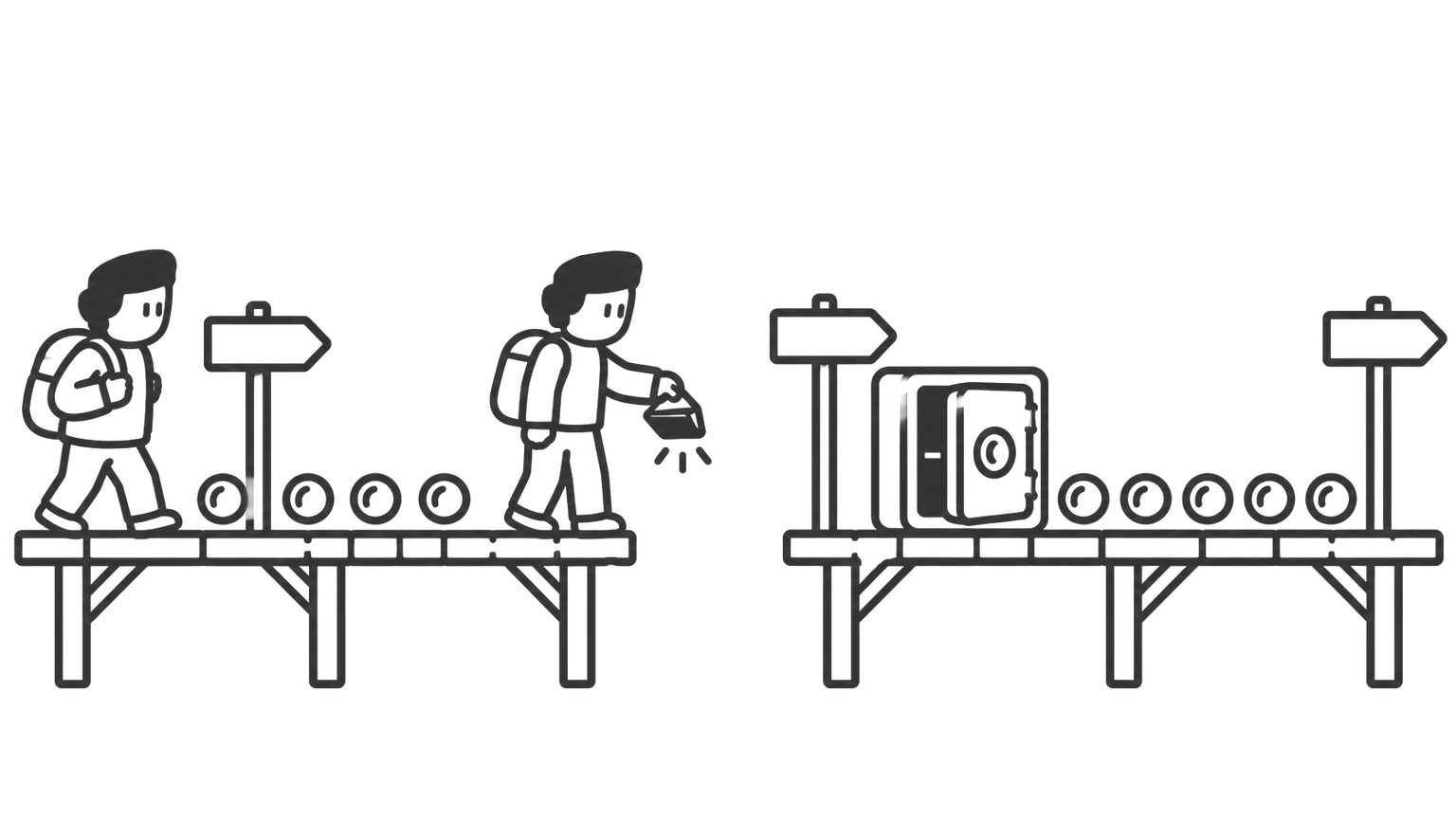
Financial planners call the years before 55 the bridge. For this couple it is seven years to 55, and seventeen to CPF LIFE at 65. Seven years at $80,000 is $560,000 against the $400,000 they hold outside CPF, a gap of $160,000. Returns on the $400,000 would stretch the table a little, but they would not close a $160,000 gap, and the gap is there in a good market too.
What Does CPF Release At 55 And 65?
According to the CPF Board's page on withdrawals from 55 (checked 27 September 2026), members who have not met their Full Retirement Sum "can withdraw $5,000 or more from your CPF savings once you reach age 55". Members who have met it can "withdraw your excess savings in your Ordinary account".
| Age | What CPF releases |
|---|---|
| Before 55 | Ordinary Account savings for housing, education and approved investments only |
| 55 | At least $5,000, plus Ordinary Account savings above the Full Retirement Sum |
| 65 | CPF LIFE monthly payouts from the Retirement Account, for life |
| Any age | MediSave, for healthcare only |
Source: CPF Board
The Full Retirement Sum is fixed by the year a member turns 55. It is $220,400 for members turning 55 in 2026 and $228,200 for 2027 (checked 27 September 2026). Bryan and Cheryl turn 55 in 2033, and the CPF Board has not yet published the sum for that year. Each of them will keep that year's Full Retirement Sum in the Retirement Account, and only the savings above it can be withdrawn at 55.
Read Also: BRS, FRS And ERS: What CPF Members Can Withdraw At 55 In 2026
How Much Will CPF LIFE Pay Them From 65?
The Retirement Account balance at 55 pays the CPF LIFE premium, and the balance keeps earning at least 4% a year until payouts start. The 4% floor on Retirement Account savings has been extended to 31 December 2027 (checked 27 September 2026).
The CPF Board publishes these estimates for members turning 55 in 2026 on the Standard Plan (CPF Board, How much CPF payouts can I get every month?, checked 27 September 2026):
| Retirement Account at 55 | Retirement Account at 65 | Monthly payout from 65 | Monthly payout from 70 |
|---|---|---|---|
| $110,200 | $170,100 | $950 | $1,280 |
| $220,400 | $330,100 | $1,780 | $2,380 |
| $440,800 | $650,100 | $3,440 | $4,580 |
Source: CPF Board
The figures are for a male member and may be adjusted for long-term changes in interest rates or life expectancy. If Bryan and Cheryl each had the 2026 Full Retirement Sum at 55, they would receive about $1,780 × 2 × 12 = $42,720 a year from 65. That covers about 53% of their $80,000 of spending, and their own savings need to cover the other $37,280 a year.
Read Also: CPF LIFE Payouts In 2026: How Much Each Plan Pays
Why The 25x Rule Does Not Fit A Retirement At 48
The 25x rule multiplies a household's annual spending by 25. That target implies a 4% withdrawal rate. It comes from studies of thirty-year retirements, and it treats every dollar as available on the first day.
Neither assumption holds for Bryan and Cheryl. A plan to 95 runs 47 years, and a rate set for thirty years is too high for 47. Two-thirds of their money is also locked for the first seven years.
By the 25x rule, $80,000 × 25 = $2,000,000, and their $1.2 million falls short of that. The 25x sum leaves out two facts. CPF LIFE covers about half their spending from 65, and their plan first fails at 53, well before the pot as a whole runs short.
Two Tests Their Plan Has To Pass
An early retirement plan with CPF savings has to pass two separate tests:
- The whole pot, CPF included, is large enough for the full retirement.
- The money outside CPF lasts until CPF savings can be withdrawn.
The couple's plan could pass the first test and fails the second, so their earliest safe stopping age is the later of the two dates. After 55, Retirement Account savings earn at least 4% in any market and CPF LIFE pays for life. Neither pays for spending before 55.
Three Ways The Couple Can Move Their Date
- Hold more savings outside CPF. For a household that is still working, this means fewer voluntary top-ups. A top-up adds to the years after 55 and takes from the years before them.
- Spend less across the bridge. Each $10,000 off their annual spending saves $10,000 × 7 = $70,000 over the seven years. Cutting $20,000 saves $140,000 and covers most of the $160,000 gap.
- Stop later. Each extra year of work shortens the bridge by one year and adds a year of saving. For most households this moves the date the most.
Bryan earns $9,000 a month and takes home $7,400 after $1,600 of employee CPF. Cheryl earns $6,500 and takes home $5,200 after $1,300. Together they take home 12 × $12,600 = $151,200 a year, and after $80,000 of spending they save $71,200.
Read Also: Is A CPF Cash Top-Up Worth It In 2026?
Read Also: See Your CPF Balances Alongside Your Retirement Plan In Cashmere Pocket
What Did Bryan And Cheryl Decide?
Bryan and Cheryl both work one more year and stop at 49. A year of saving lifts their money outside CPF to $400,000 + $71,200 = $471,200. They plan to spend $78,000 a year from 49, so the six years to 55 cost 6 × $78,000 = $468,000, before any investment returns.
A large CPF balance suits households that plan to retire at 60 or 65, since it earns a steady return and pays out for life. Households that plan to stop well before 55 need to size the years before 55 separately, using only the money they can reach, and the right mix depends on their spending, their savings outside CPF and the age they choose.